
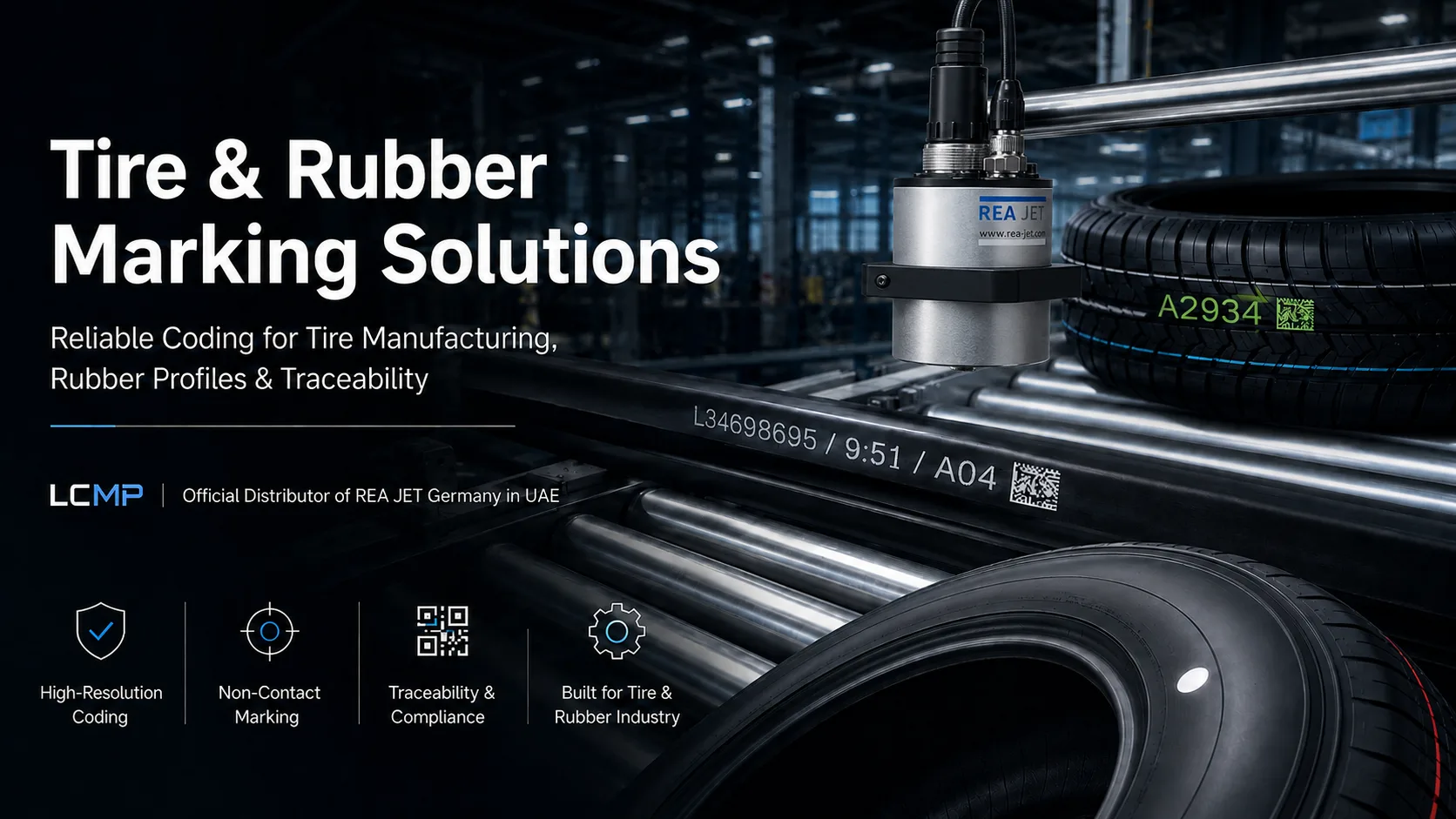
Tire and Rubber Marking Solutions in UAE: Advanced Coding for Rubber Products, Tire Manufacturing and Industrial Traceability
Reliable Marking and Coding Technologies for Tire, Rubber and Automotive Manufacturing
Tire and rubber manufacturing requires accurate, durable and reliable product identification throughout every stage of production. From raw material preparation and rubber compounds to tread lines, finished tires, labels and logistics, marking and coding plays an important role in traceability, quality control, process automation and supply chain management.
Across the UAE and GCC, the demand for high-quality tire and rubber products continues to grow due to industrial development, automotive services, logistics expansion, construction activities and regional mobility requirements. Manufacturers and processors in this sector require marking systems that can operate reliably in demanding production environments while maintaining clear and readable codes on rubber surfaces, semi-finished components and finished products.
Industrial marking and coding solutions for tire and rubber applications can support:
- Batch and lot identification
- Rubber compound traceability
- Tread line marking
- Defect marking
- Tire sidewall marking
- High point marking
- Color line marking
- 2D code and barcode printing
- Finished tire labeling
- Logistics and warehouse identification
- Quality control processes
- Production automation
- Product lifecycle tracking
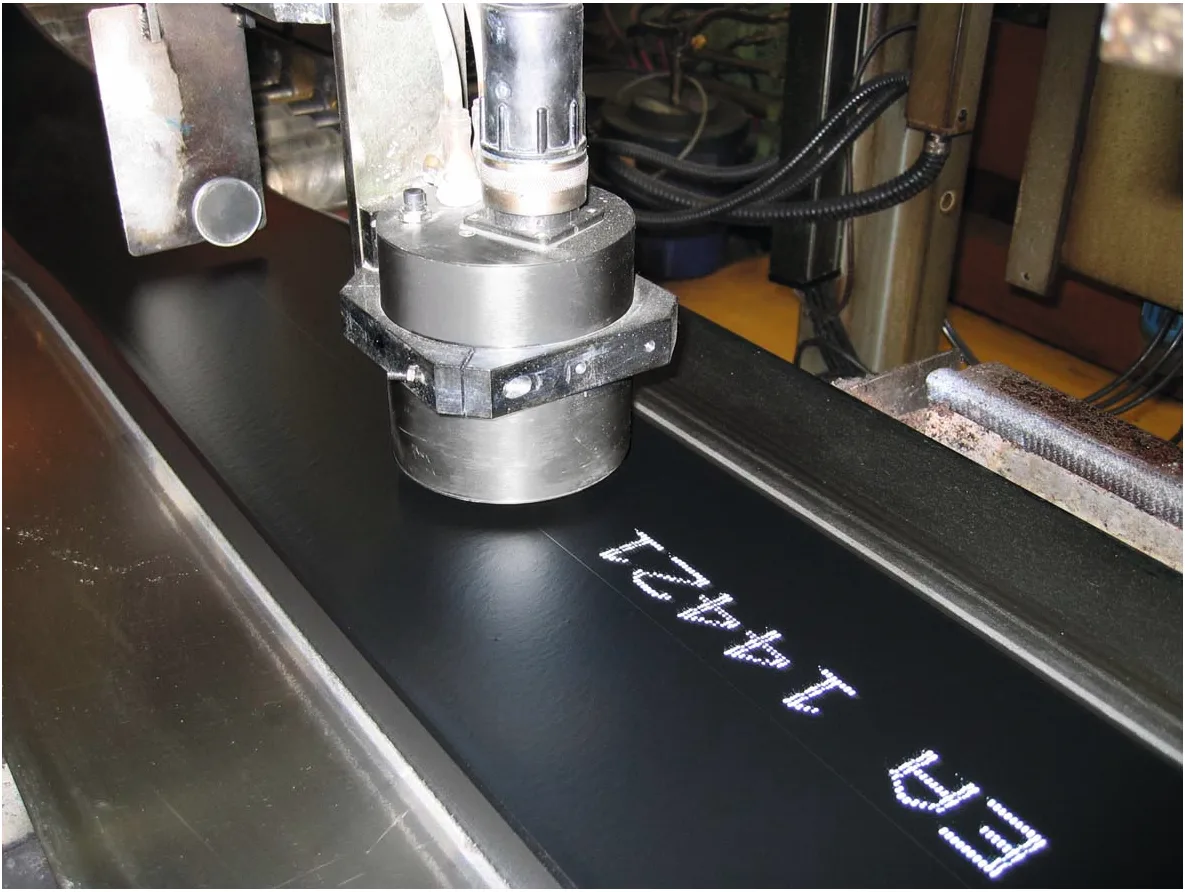
REA JET provides a wide range of technologies for tire and rubber marking, including large character inkjet systems, high-resolution inkjet printers, spray mark systems, laser marking systems, labeling systems, inks, paints and consumables.
LCMP Printing Machinery Trading L.L.C, the official Distributor of REA JET Germany in UAE, supports industrial customers across the Middle East with marking and coding solutions for tire, rubber, automotive, logistics and manufacturing applications.
Why Tire and Rubber Marking Is Important
Tire and rubber production includes many stages, and each stage requires accurate identification. Without reliable marking, manufacturers may face production errors, material mix-ups, quality issues and traceability gaps.
In tire and rubber manufacturing, marking helps identify:
- Material batches
- Rubber compounds
- Semi-finished components
- Production line information
- Quality status
- Defect locations
- Tire building references
- Finished tire data
- Logistics information
- Product labels
- Customer-specific requirements
Reliable marking is especially important because tire and rubber production often involves high-volume manufacturing, multiple material types, strict quality requirements and complex production workflows.
For manufacturers in the UAE and GCC, traceability is becoming increasingly important as companies improve automation, reduce waste and support international quality expectations.
Challenges in the Tire and Rubber Industry
Tire and rubber production includes many stages, and each stage requires accurate identification. Without reliable marking, manufacturers may face production errors, material mix-ups, quality issues and traceability gaps.
In tire and rubber manufacturing, marking helps identify:
- Material batches
- Rubber compounds
- Semi-finished components
- Production line information
- Quality status
- Defect locations
- Tire building references
- Finished tire data
- Logistics information
- Product labels
- Customer-specific requirements
Reliable marking is especially important because tire and rubber production often involves high-volume manufacturing, multiple material types, strict quality requirements and complex production workflows.
For manufacturers in the UAE and GCC, traceability is becoming increasingly important as companies improve automation, reduce waste and support international quality expectations.
Marking Along the Tire Manufacturing Process
Tire production is not a single-step process. It includes multiple production phases where marking may be required.
Typical marking points include:
1. Mixing and Raw Material Preparation
At the mixing stage, rubber compounds and materials must be clearly identified. Bags, batches and compound materials may need high-resolution coding, barcodes or lot numbers to ensure correct material handling.
2. Semi-Finished Products and Components
During the production of semi-finished components, marking may be required on rubber sheets, tread material, steel-textile cord and other tire components.
3. Tire Building and Quality Control
Marking supports tire building by helping operators and automated systems identify component direction, position, quality status and traceability data.
4. Finished Tires
Finished tires may require color line marking, high point marking, sidewall identification, laser marking, labels and logistics codes.
5. Warehousing and Logistics
Labels, barcodes, QR codes and machine-readable data support warehouse management, shipment control and supply chain traceability.
By applying the correct marking technology at each stage, manufacturers can improve production control and reduce the risk of errors.
EVA Bag Marking for Rubber Ingredients
In tire production, rubber ingredients and compounds are often packed in bags before being used in the manufacturing process. These bags need accurate identification to prevent material mix-ups.
EVA bag marking can include:
- Batch numbers
- Lot codes
- Barcodes
- Weight information
- Recipe numbers
- Production dates
- Tracking data
High-resolution marking on bags supports better material traceability and can be integrated with backend systems for production control.
Key advantages include:
- Improved quality process
- Reduced scrap production
- Better tracking and tracing
- Lower operating cost compared with some manual methods
- Maintenance-free print system options
- Improved visibility of material data
For UAE and GCC rubber manufacturers, this type of marking can help improve raw material control and reduce mistakes during production.
Rubber Compound Marking
Rubber compounds must be clearly identified before they move to the next production stage. Traditional paper-based batch identification can be lost, damaged or removed during handling.
Direct compound marking provides a more reliable alternative.
Compound marking can include:
- Alphanumeric codes
- Batch numbers
- Lot numbers
- Material identification
- Color coding
- Production references
Depending on the application, solvent-based or water-based inks may be used. Special colors such as red, orange and yellow can support visual identification and process control.
Advantages of compound marking include:
- Permanent marking compared with paper-based batch identification
- Reduced scrap risk
- Lower chance of wrong extruder loading
- Higher readability compared with some traditional coding methods
- Improved traceability during production
- Better support for quality control
For tire and rubber manufacturers, this helps reduce production mistakes and improve material flow between departments.
Tread Line Marking
Tread line marking is an important application in tire production. It helps identify tread material, track production data and support quality control.
Tread line marking can include:
- Alphanumeric marking
- 2D codes
- Defect marking
- Non-compliant tread identification
- Process data
- Tracking and tracing information
A key advantage of modern inkjet marking is contact-free printing. This means the marking system does not mechanically touch the tread material, helping avoid product deformation or mechanical impact.
Benefits of tread line marking include:
- Full traceability
- Scrap reduction
- Support for quality improvement programs
- Replacement of wheel coders in suitable applications
- Reduced manual intervention
- Improved production reliability
For manufacturers working with large volumes of tire components, contact-free tread marking can improve both quality and process efficiency.
Steel-Textile Cord Marking
Steel-textile cord marking supports tire building and traceability by identifying materials used in tire reinforcement structures.
Marking on steel-textile cord can include:
- Alphanumeric identification
- Defect marking
- Out-of-specification marking
- Production line information
- Tracking data
In some applications, solvent-based ink can support adhesion requirements and improve marking performance.
Advantages include:
- Improved tracking and tracing
- Better quality control
- Support for tire building processes
- Defect identification
- Improved production visibility
This type of marking is important where material orientation, batch information and quality status must remain visible during further processing.
Finished Tire Marking
Finished tires may require several types of marking depending on production, quality, customer and regulatory requirements.
Common finished tire marking applications include:
- Line marking
- High point marking
- Wheel identification
- Sidewall marking
- Laser marking
- Customized marking
- Tire labeling
- Logistics labeling
Each application serves a different purpose. Some markings support manufacturing and assembly, while others support logistics, regulations, retail distribution or final customer identification.
Line Marking for Finished Tires
Line marking is used to apply colored or visible lines on tires. These lines help identify tire type, production details, assembly information or logistics references.
Modern line marking systems can support:
- Permanent solid lines
- Multiple lines
- Automated color changes
- Reduced manual color changes
- Automated positioning
- Better repeatability
Advantages include:
- Scrap reduction
- Reduced risk of color mix-up
- Increased product quality
- Lower adjustment effort
- Cost reduction through automation
For tire manufacturers, automated line marking improves consistency and reduces the need for manual intervention.
High Point Marking
High point marking is used in tire manufacturing to identify specific points on the tire for balancing, assembly or quality purposes.
High point marking can include:
- Colored marks
- Alphanumeric codes
- Line striping
- Customized marks
Advantages include:
- Better compliance with manufacturing requirements
- Improved production process
- Support for international rules and regulations
- Cost reduction through automation
- Improved product handling during assembly
This application is especially important where accurate wheel and tire matching is required.
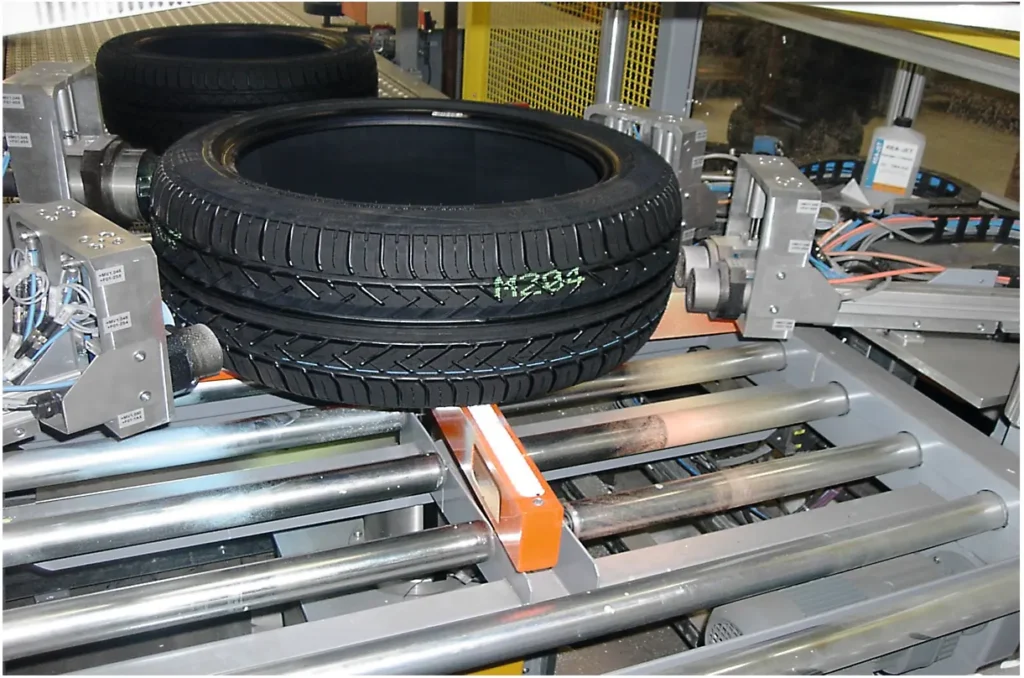
Wheel Identification Marking
Wheel identification marking can be used at assembly lines to support product recognition and automated production workflows.
In some cases, water-removable marking may be used where the mark is required during production but not intended to remain permanently on the finished product.
Advantages include:
- Replacement of manually applied codes
- Increased product quality
- Cost savings through automation
- Better control during assembly
- Reduced manual handling
This helps manufacturers improve process flow while maintaining flexibility.
Laser Marking for Tires and Rubber Products
Laser marking is a strong solution when permanent, durable and consumable-free marking is required.
Laser marking can be used for:
- Alphanumeric codes
- 2D codes
- Customized marking
- Product identification
- Tire sidewall marking
- Rubber component marking
- Long-term traceability
Advantages of laser marking include:
- Permanent marking
- Durable readability
- Consumable-free operation
- Support for track and trace
- Reduced operating costs for suitable applications
- Compliance with production and customer requirements
Laser marking is especially useful for applications where the marking must remain readable throughout the product lifecycle.
High-Resolution Marking for Rubber Products
High-resolution inkjet marking is suitable when manufacturers need clear, sharp and machine-readable codes on rubber products, labels, bags or components.
High-resolution marking can support:
- Barcodes
- 2D codes
- QR codes
- Data Matrix codes
- Batch numbers
- Logos
- Text
- Product identification
Benefits include:
- High-quality print
- Clear and crisp marking
- Machine-readable codes
- Extended data capacity
- Support for track and trace
- Reduced manual roll coding
- Faster label and content changes
High-resolution marking can also support product lifecycle tracking and automated identification.
Tire Labeling and Logistics Identification
Finished tires often require labels for product information, regulation, warehousing and shipment.
Tire labeling can include:
- Product labels
- Regulatory labels
- Logistics labels
- Barcode labels
- Print-and-apply labels
- Pre-printed labels
- Customer-specific labels
Automated tire labeling helps manufacturers improve:
- Supply chain integration
- Regulatory compliance
- Warehouse control
- Product identification
- Shipping accuracy
- Cost efficiency
A complete tire marking solution may combine inkjet marking, laser marking and labeling systems to support the full production and logistics process.
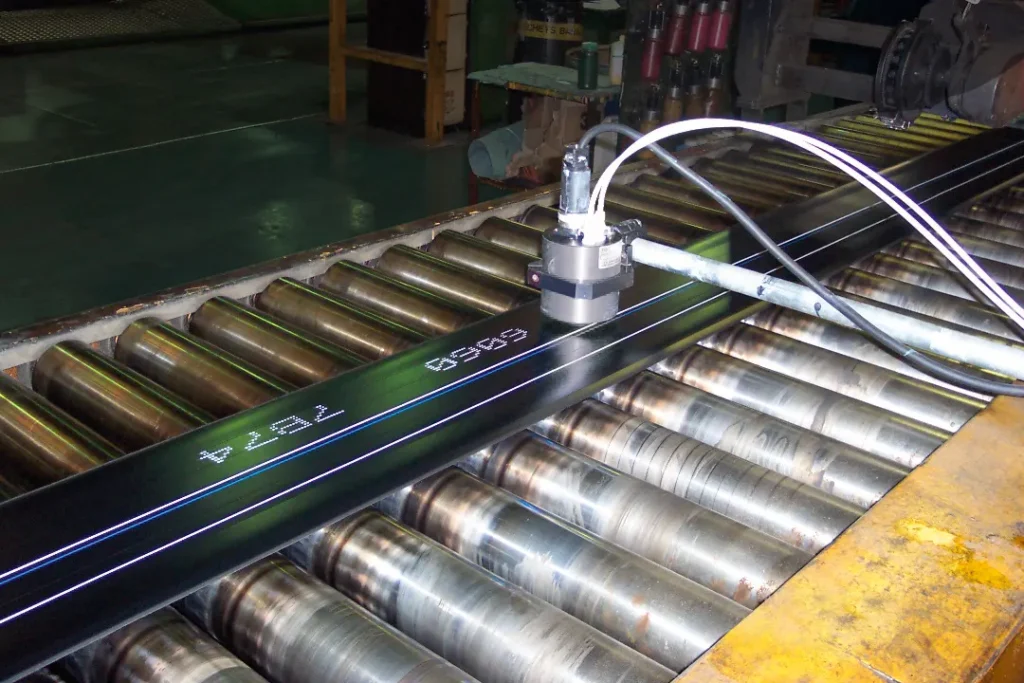
REA JET DOD 2.0 for Tire and Rubber Applications
REA JET DOD 2.0 is suitable for large character marking and demanding rubber production applications.
It can support:
- Contact-free printing
- Marking on rubber surfaces
- Large character codes
- Harsh industrial environments
- Dust, humidity and temperature exposure
- Vibration-prone production areas
- Durable industrial operation
For the tire industry, contact-free marking is especially important because rubber surfaces can be sensitive during production.
DOD technology can be used for compound marking, tread marking and other rubber production processes where robust coding is required.
Inks and Consumables for Rubber Marking
The correct ink is essential in tire and rubber applications.
Depending on the process, manufacturers may require:
- Solvent-based inks
- Water-based inks
- Colored inks
- Permanent marking inks
- Disappearing marking inks
- Adhesion-supporting inks
- Environmentally friendly ink options
Permanent marking may be required when the code must remain readable after curing or throughout the product lifecycle.
Disappearing marking may be used when the mark is only required before curing and should disappear during later process stages.
Water-based ink options can support greener production approaches, while solvent-based inks may be required in certain adhesion-critical applications.
Correct ink selection depends on:
- Rubber material
- Production stage
- Curing process
- Required durability
- Surface condition
- Color visibility
- Environmental requirements
- Quality control needs
Automation and Track & Trace in Tire Manufacturing
Modern tire and rubber production is increasingly connected to digital traceability systems.
Marking and coding can support:
- Automated product identification
- Backend system integration
- Production data tracking
- Batch traceability
- Material control
- Defect identification
- Quality assurance
- Logistics tracking
- Product lifecycle tracking
Machine-readable codes such as barcodes, QR codes and Data Matrix codes help manufacturers connect physical products with digital production records.
This is important for smart manufacturing, Industry 4.0 concepts and modern quality management systems.
Applications in UAE and GCC Industry
Tire and rubber marking solutions are relevant for multiple industries across the UAE and GCC.
Tire Manufacturing and Retreading
Marking supports production control, quality identification, tire labeling and logistics.
Rubber Product Manufacturing
Rubber parts, sheets, compounds and molded products require identification for traceability and quality management.
Automotive Industry
Automotive components require durable marking for production, assembly and lifecycle tracking.
Logistics and Warehousing
Labels, barcodes and product identification support storage, inventory and shipment control.
Industrial Components
Rubber seals, belts, hoses and technical parts require product identification and quality tracking.
Manufacturing and Export
Clear marking supports export documentation, product identification and customer-specific requirements.
Why Local Support Matters
Selecting the correct tire and rubber marking system requires careful application study.
Important factors include:
- Rubber type
- Surface condition
- Production speed
- Required marking durability
- Curing process
- Color visibility
- Automation level
- Data integration requirements
- Environmental conditions
- Maintenance expectations
Local technical support is important because tire and rubber production environments can be demanding. Equipment must be installed correctly, operators must be trained, and inks or consumables must be selected according to the application.
LCMP Printing Machinery Trading L.L.C supports manufacturers in the UAE and Middle East by helping select suitable REA JET marking and coding technologies for tire, rubber and industrial applications.

How LCMP Supports Tire and Rubber Marking Projects in UAE
LCMP Printing Machinery Trading L.L.C is the official Distributor of REA JET Germany in UAE and supports industrial customers across the Middle East with advanced marking and coding technologies.
LCMP provides support for:
- Tire marking solutions
- Rubber product marking
- Compound marking
- Tread line marking
- Finished tire marking
- High point marking
- Tire labeling
- Laser marking systems
- High-resolution inkjet systems
- DOD large character marking
- Spray mark systems
- Ink and consumable selection
- Production line integration
- Technical consultation
- After-sales support
LCMP supports a full range of REA JET technologies, including:
- REA JET HR 2.0
- REA JET DOD 2.0
- REA JET SC 2.0 continuous inkjet
- REA JET UP
- REA JET Laser CO2
- REA JET Fiber Laser
- REA JET ST spray mark technology
- REA JET labeling solutions
- Industrial inks and REA JET cartridges
- Rubber marking inks and consumables
This allows manufacturers to choose the most suitable technology according to the production stage, material type, required durability and traceability needs.
Get in contact with us
OUR CONTACT PERSONS ARE ALWAYS AT YOUR DISPOSAL
Links reference


Conclusion
Tire and rubber manufacturing requires reliable marking and coding throughout the entire production process. From raw material bags and rubber compounds to tread lines, steel-textile cord, finished tires, labels and logistics, every stage benefits from accurate identification.
Advanced marking technologies such as REA JET DOD 2.0, REA JET HR 2.0, REA JET Laser CO2, REA JET Fiber Laser, spray mark systems and labeling solutions can help manufacturers improve traceability, reduce scrap, support automation and meet quality requirements.
For UAE and GCC manufacturers, these solutions are especially valuable as the region continues to grow in automotive services, industrial manufacturing, logistics and export activities.
LCMP Printing Machinery Trading L.L.C, as the official Distributor of REA JET Germany in UAE, provides local support, technical consultation, system integration and after-sales service for tire and rubber marking applications across the Middle East.
Links reference