Pallet marking by inkjet printer
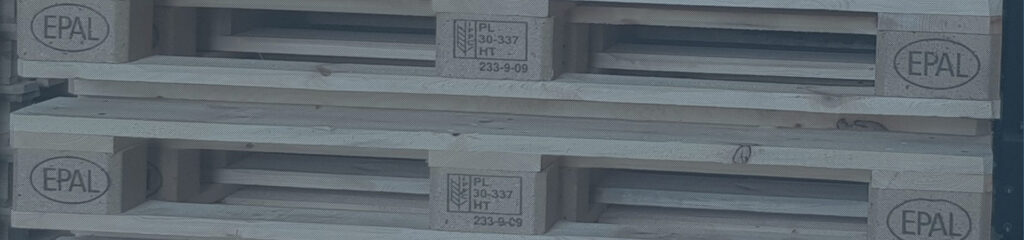
EPAL, IPPC, EUR and Logos Pallets are always in use in logistics as a means of transport and storage, are used worldwide and have become indispensable. They optimize transport, storage in confined spaces and the loading of stackable goods. Sometimes they are disposable pallets, sometimes reusable pallets. Sometimes they are made of wood, sometimes they are made of plastic, corrugated cardboard or steel. The variety is huge, as are the requirements for pallet marking. Pallets must be clearly identifiable and tamper-proof. This is achieved by marking the pallet blocks, which are manufactured in different shapes, sizes and numbers. The pallet blocks provide information about which organization manufactured the pallet or whether the pallet is free of pests (IPPC marking). In addition to the standardized, required marking of pallets, alphanumeric information or manufacturer logos can also be found on the pallet blocks. Depending on the requirements, the print content for pallet marking also varies. In order to react quickly to changing print content, a flexible marking system is required. REA has addressed precisely this requirement with the development of the new REA JET GK 2.0 PA (Pallet Application). Small batches, order-related print jobs and large batches can be flexibly marked with the software extension of the REA JET GK 2.0 PA – regardless of the pallet type. For this purpose, the number of blocks to be marked and the print content to be printed are stored on the controller. After successful printing, the next pallet from the same series or the next print job follows. In the case that printing was not triggered for each block and thus the defined number of blocks was not marked, a signal can optionally be issued to stop the conveyor system. In this way, the software ensures that only perfectly and clearly marked pallets are produced. An alternative solution is offered by the REA JET HR inkjet printer with its maintenance-free, cartridge-based printing technology. With this coding and marking system, print content up to 50.4 mm print height (12.7mm per print head) can be applied directly to absorbent surfaces in a clean, environmentally friendly and solvent-free manner. Applications Areas of service application
Unique Device Identification (UDI)

Unique coding and marking of medical devices to increase patient safety The EU Medical Device Regulation (MDR) 2017/745 of the European Union obliges producers, distributors, importers and EU representatives of medical devices or their packaging to clearly mark their products as of May 26, 2021. Medical devices will thus be completely traceable from the manufacturer to the user and guarantee the patient safety required by the EU. The standards and regulations passed in accordance with the Medical Device Regulation are equally binding for all players. To this end, the product identification required for the medical device is issued by one of the four allocation authorities – GS1, HIBCC, ICCBBA and Informationsstelle für Arzneispezialitäten. From May 2022, all medical devices will be stored bit-by-bit in the EU-wide EUDAMED database with their master data and the “Unique Device Identification” (UDI). The product identification consists of two components: Classify medical devices correctly Risk classes and categories Medical devices are categorized and classified into risk classes, which are defined by the intended purpose in terms of the place and duration of use of the product. There are e.g. products for single use or reusable medical devices, implants or others like software and devices. The resulting risk classes then also specify the implementation deadlines in legislation. Where must the UDI marking be applied? Direct marking by ink, laser or label The product identification must be applied either directly on the product, on primary packaging or on all higher packaging levels. According to the Medical Device Regulation the direct marking must be applied by ink, laser or label.In addition, the code must be easily accessible and readable both in the warehouse and when the product is in use – and this throughout the entire life of the product.
Direct cardboard marking
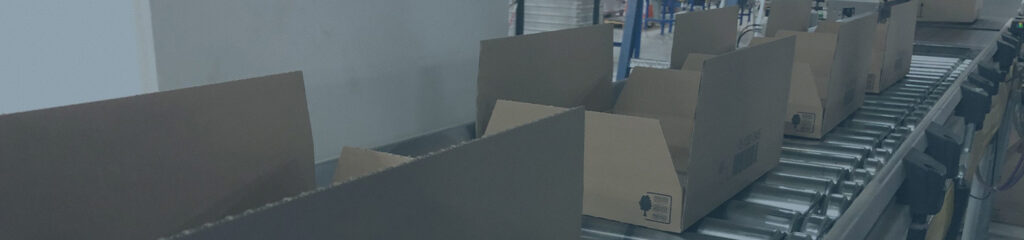
Digital direct marking of primary and secondary packaging Cardboard boxes and cartons made of paper and cardboard are ideal as primary and secondary packaging for transporting and storing products safely and reliably throughout the entire transport chain to the customer. Above all, primary and secondary packaging must be reliably marked with a range of important information. Important information that serves to support logistics (movement of goods, traceability) and consumer protection. These are: This information can get onto the packaging in a number of ways: Marking with digital direct printingSustainable, flexible and cost-efficient solution Digital direct printing – especially compared to pre-printed cardboard and labels – is cost-efficient, flexible and sustainable, and thus meets the industry’s spirit of the times. The printers for direct cardboard marking are small, compact and can be easily integrated into the production line even when space is limited. Contact-free, static and variable data can be applied captively with direct printing. Combinations of static print content such as logos or symbols and variable print content such as date, time, counter or shift code are just as possible as pure variable or static data. They thus allow the greatest possible scope for individualizing the print content. Even greater flexibility is provided by a printing system with flexible print head alignment. While the space available for the information to be conveyed is limited in the case of labels, large and at the same time high-resolution print images with all the relevant information can be generated in digital direct printing. Barcodes and 2D codes can also be imaged reliably and with the required edge sharpness and contrast. Several print heads can be used in cascade to increase the print area. Digital printing systems are generally low-maintenance and require nothing more than new ink on a regular basis. This eliminates the need to stock pre-printed cartons. Likewise for pre-printed labels. Materials management is simplified by low-maintenance printing systems. This is because changeover times, which otherwise occur during ongoing operation and cause machine downtimes, can thus be reduced to a minimum. What are the advantages of direct cardboard marking? Which coding and marking system is suitable for direct cardboard marking? REA JET GK 2.0 – High resolution inkjet printer: The new generation of High Resolution Inkjet Printer REA JET GK 2.0 prints freely combinable texts, logos and graphics with variable print data. A horizontal resolution of up to 1,200 dpi ensures print results with high edge definition – and at print heights of up to 100 mm. With their compact design, the devices can be easily integrated into production. What’s more, they are fully Industry 4.0-capable.
Late Stage Customization
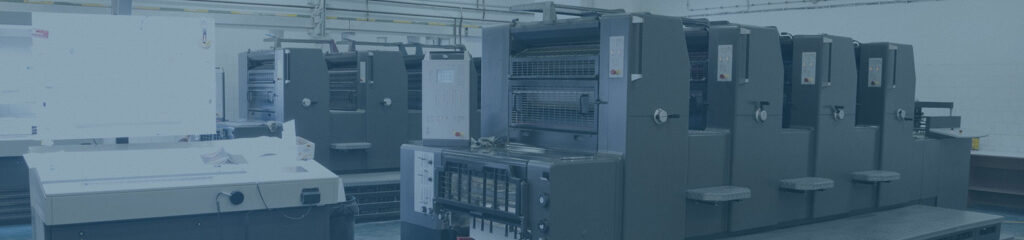
Digital inline printing of variable data Customization and personalization of labels and print products made easy by REA JET maintenance free inkjet printers. Address the raising customer demand of backside numbering or printing gaming codes with the REA JET late stage customization portfolio. REA JET combines the cartridge based inkjet printers REA JET HR pro and HR pro OEM, the promotion software for secure print of variable data and the vast ink portfolio to a competitive solution. Applications Areas of service application
Wet-on-wet printing

Direct printing instead of label Important information must be clearly readable. On smooth surfaces as well as transparent and dark substrates, this is already a challenge. Labels were therefore always well suited for packaging made of smooth plastics, or foil – especially for transparent or dark materials. Likewise, important data on products made of metal, such as drywall profiles, preferred to be printed on a label that was then applied. Especially in times of massive shortages of primary materials, sustainability, and resource conservation, switching to “wet-on-wet” direct printing is a real alternative to self-adhesive labels. What is wet-on-wet printing? Novel printing process in one work step In wet-on-wet printing, two or more colors are printed in immediate succession – without any drying time in between. This means that color mirrors, codes and plain text are printed in a single step. The color mirror is applied first, and important information is printed on it in the same step – either with black or colored ink, but in any case in high resolution. The color mirror and marking then dry together in a very short time. This innovative wet-on-wet printing process neither limits production output nor does the readability of the printed image suffer. Quite the opposite. The previous drying time is eliminated, printing takes place in a single step, and contrast is optimal. Thus, the new printing process enables a high first-pass reading rate for 1 and 2D codes, text lines and logos with variable information such as date, time, counter, shift code and database content. Which coding and marking system is used to implement this printing technology? High Resolution Inkjet Printer and Inline Print Control Innovative wet-on-wet printing is implemented with the REA JET HR Inkjet Printer. With HP cartridge technology and a resolution of up to 600 dpi, it prints codes, texts and logos in one work step – in direct succession, without interruption or drying time. This is because the use of newly developed inks means that smooth or transparent surfaces, such as foils, plastic or metal, can be marked cleanly, in an environmentally friendly manner and without solvents. The result is high-contrast, clearly readable, captive, and all this at high printing speeds. This produces print images up to 12.7 millimeters high per print head, and several print heads can be cascaded for images up to 50.8 millimeters high. Hot swap function The “hot swap function” enables cartridges to be changed during operation. As each cartridge is supplied with a new print head, the system is maintenance-free, ensuring uninterrupted product marking. Heatable print heads ensure unchanged high print quality even in cold production environments. Inline printing process The wet-on-wet printing process can be ideally combined with the innovative REA Inline OCR solution: Mounted above the conveyor belt and equipped with powerful optical text recognition (OCR) software, a camera system reads marking and codes on passing product packages and checks their accuracy. Capture and complete evaluation are completed in the shortest possible time, at just 70 milliseconds per print element. Completely integrated into the production and packaging process, it ensures that only fully and correctly marked goods are delivered. What are the advantages of wet-on-wet printing? Clearly readable, high contrast and abrasion resistant
Avoid incorrect labeling
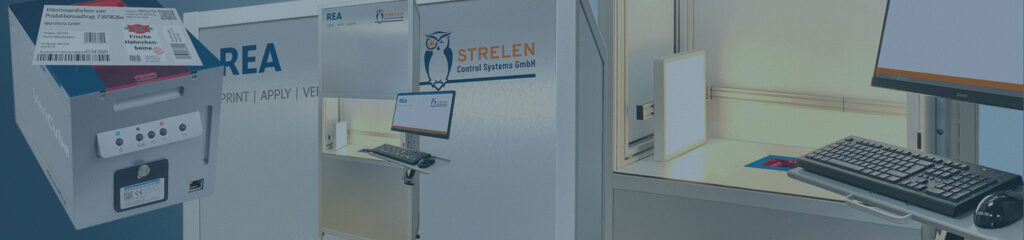
Why verify label layouts and contents? Label layouts and contents on packaging and products must not only be 100% present, but also correct and legible. Because clearly visible, legible and correct data is essential for manufacturers and retailers to comply with legal requirements, carry out controls during import, prevent contractual penalties or avoid complaints and expensive recalls. Quality control and avoidance of errors during labeling and marking are the decisive keywords here! How can errors be avoided during labeling and marking? Visual inspection and dual control principle Visual inspection during quality control can reduce, but not eliminate, confusion of print layouts or labels, number errors, incorrect language selection or simply careless mistakes. Furthermore, visual inspection requires a considerable amount of time and personnel and still contains a residual risk despite the dual control principle. It is also tricky if the product has been correctly marked, but in the wrong language. Not every employee can speak several languages fluently or recognize immediately and without doubt which language it is. The fact that a product has been labeled in the wrong language is usually only noticed after numerous batches have been produced. Inline controls would be a solution, but simply not practical. The associated setup effort for the variety of different packaging such as stretch foil, cardboard boxes, tubular bags, etc., would cause the effort and costs to explode. Innovative solution Verification before production starts An innovative solution for verifying codes and layouts is digital image processing combined with artificial intelligence, which opens up new efficient and reliable ways of quality control. Label data can thus be verified quickly and reliably for presence, correctness, readability and completeness. It is irrelevant whether the data is static or variable. The labels are verified before production begins. For this purpose, the software is taught a product range of any size in a previous step. After scanning these sample sheets, first the individual labels are defined in a clear and well-structured mask, followed by the respective data – usually an EAN code, the label number, the best-before date, the LOT number and a QR code. If production is now to start, all the required labels or foils of the product are placed on a test sheet for checking, which is then compared with the stored sample sheet from the database. If the system determines that all data is correct, production can start. If there is a discrepancy between label data and the data stored in the system, an error is reported, which can then be corrected before production begins. In the inspection process, all types of labels, including outer packaging labels, are recognized and all identification numbers, codes, lot numbers and best-before dates are compared with the stored data set. Industry-compatible complete solution from a single source Verify codes, fonts and layouts – avoid errors and costs Together with the expert for image processing and automation Strelen Control Systems GmbH we offer a complete total solution for measuring code verification according to ISO standards and layout control – the REA LabelTower. The layout check by Strelen Control includes a plain text check, a check of graphic elements as well as variable data. Code verification by the REA VeriCube verifies code properties, contrasts and print precision. The REA VeriCube transfers the captured image with the verification result to the Strelen software. There, a check is made for the correctness of the plain text or the entire label layout. The final verification result consists of the measurement-based code verification according to ISO/IEC standards and the layout check based on the label taught in before the start of production. Only when codes, fonts and layouts have passed the inspection is production released – no errors, no costs! Advantages of automatic verification by Strelen and REA Flexible, reliable detection and easy operation